Handcrafted Kubb Set
$75Heavy hardwood blocks and batons that survive years of backyard playoffs. Viking lawn chess, built to last. Custom finishes on request.
♥ for the love of play ♥
Handmade games for the yard and the table. Every one comes with its story, its rules, and free plans to build your own. Rather I make it for you? That is what the order button is for.
Heavy hardwood blocks and batons that survive years of backyard playoffs. Viking lawn chess, built to last. Custom finishes on request.
A bocce-style throwing set with a Moehr twist. Roll, measure, and argue about whose ball is closer. Comes with a pocket measure for the close calls.
Net, legs, and balls for fast three on three roundnet. Sets up in a minute, packs down in two, fits in a backpack.
A Finnish pin-toss set of numbered birch skittles. Deceptively simple, secretly cutthroat. First to exactly 50 wins.
Tournament-spec boards finished however you like. Tell me the colors and the logo, I build the rest. Bags included.
A handcrafted wooden flicking board out of Ontario: snap your discs into the center hole and knock your opponent's off the board. The prettiest game I make, and the one nobody puts down.
Saskatchewan's game of bones, basically Kubb's prairie cousin. Knock down the guards first, then clear the soldiers. A painted hardwood set built for years of yard battles.
A German beer-garden classic: everyone gets a nail started in a log round, and you take turns swinging at yours with the narrow peen end of the hammer. First to drive their nail flush into the wood wins. (Sold as Stump, since the Hammer-Schlagen name is a registered US trademark.)
The French cousin to bocce: steel boules you throw flat-footed at the little jack. A proper set with a carry case, ready for the driveway or the park.
A polished hardwood board from South Asia: flick the striker to pot your discs in the corner pockets, like billiards for your fingers. Huge across India, a hidden gem here.
Three hand-drawn pixel-art takes on this game. Tell me which number wins and I will make it the cover.
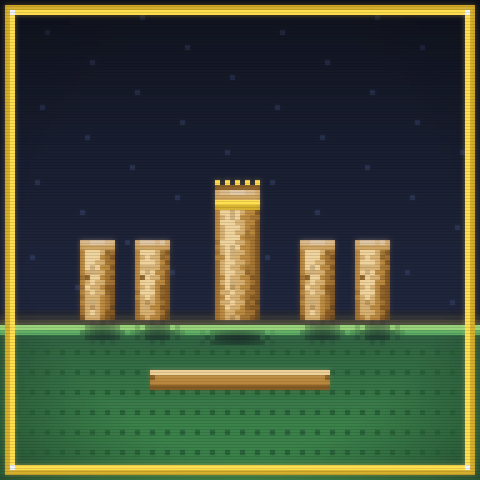
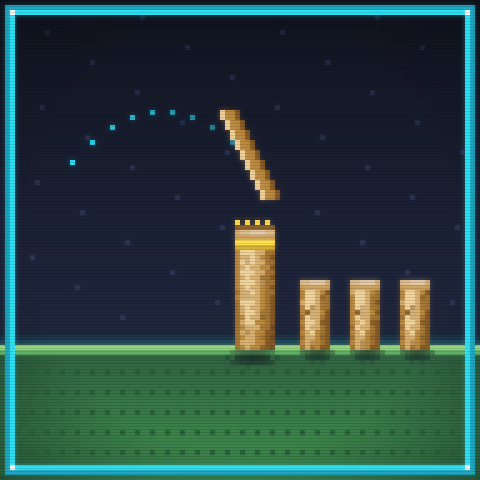
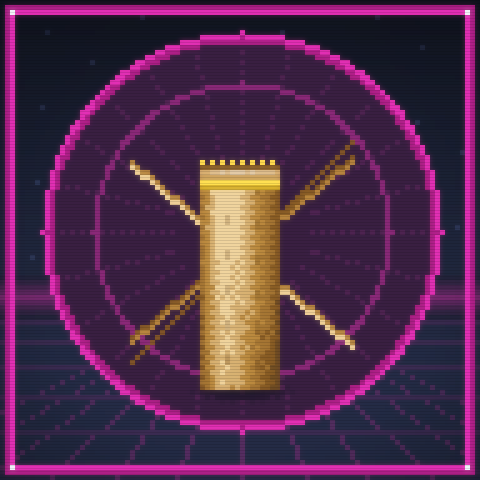
Kubb is a lawn game where two teams take turns throwing wooden batons to knock over each other's wooden blocks, then race to topple the king in the middle. People love to call it "Viking chess" because there is a lot of strategy under the simple surface: you decide which blocks to clear, where to toss the ones you knock down, and when to go for the king. Miss your timing and you hand the win to the other side.
It is a joy because anyone can pick it up in two minutes and play it with a beer in one hand, yet good players obsess over throwing technique and field position. It works on grass, sand, or gravel, it plays great with kids or grandparents on the same team, and it turns a backyard or a beach into a tournament. That mix of dead-simple rules and real depth is exactly why it travels so well.
Kubb comes from Gotland, the large Swedish island in the Baltic Sea, which is widely treated as the home of the game. You will hear it called a Viking game, and that nickname sells a lot of sets, but there is no archaeological or documentary evidence that the Vikings played it. That romantic origin story is mostly 20th century marketing. The name itself traces back to a Gotlandic and Old Norse word for a block or chunk of wood, which is a nice clue to how old and folksy the underlying idea of throwing sticks at blocks really is.
The documented trail is more recent. A skittles style war game resembling kubb appears in the 1911 second edition of the Swedish encyclopedia Nordisk familjebok, which is why 1911 sometimes gets cited as a birth year. The earliest reference to the game by the actual name "kubb" comes from 1931, when an ethnologist recorded it during fieldwork on Fårö, a small island just off Gotland. The game caught fire again in the late 1980s as a beloved Gotland summer pastime, the first Kubb World Championship was held in Rone on Gotland in 1995, and by 1998 the Swedish toy company Brio was producing inexpensive factory made sets for the international market, which helped spread it across Europe and to the United States.
A weekend build from one fence post and a length of dowel: cut, sand, and you have a tournament-legal Kubb set. Beginner friendly, about 2 to 3 hours of active work.
⬇ Download the build plansFor the love of play: build one yourself with the free plans, or let me make it for you.
Three hand-drawn pixel-art takes on this game. Tell me which number wins and I will make it the cover.
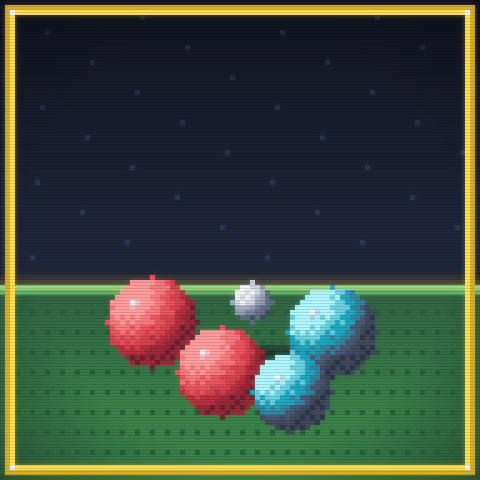

Bocce is the friendliest target game there is. One team rolls a little ball called the pallino out onto the ground, and then both teams take turns rolling their heavier balls, trying to land closest to it. That is the whole heart of it. You can play on a manicured court, but a flat patch of grass, a stretch of beach, or a gravel driveway all work just fine.
What makes bocce a joy is that anyone can play on the first throw and still be in it on the last. A kid can beat a grandparent. You can roll it soft and sneaky to nudge in close, or fire it hard to knock a rival ball out of the way. There is gentle trash talk, there is a measuring tape coming out to settle a one centimeter argument, and there is usually a drink in your other hand. It is slow in the best way, the kind of game that turns a backyard into a hangout.
Ball-rolling target games are ancient. People in Egypt and the eastern Mediterranean were tossing polished stones at marks thousands of years ago, and the Romans took up a version they played with hard olive wood balls and even coconuts brought back from Africa. By the Roman era the game was widespread, and over the centuries that same root spread across Europe and branched into close cousins: English lawn bowls and French petanque all share that common Roman ancestry. The word bocce comes from the Italian for the balls themselves.
The modern game took its present shape in Italy in the 1800s, when it picked up well defined rules and standardized equipment. Italian immigrants carried bocce around the world in the late 19th and 20th centuries, which is why you find well worn courts in Italian neighborhoods, social clubs, and parks from Argentina to Australia to the United States. Today the sport is governed internationally by the Federazione Italiana Bocce and the Confederation Mondiale des Sports de Boules, with three main competitive styles (Raffa, Volo, and Punto) and a huge, happy backyard following that never reads the rulebook at all.
Bocce is one to buy rather than build. A genuinely good set lives or dies on the balls, and getting them right means matched, molded, perfectly round balls of even weight and density, which is just not something you can turn out well in a home shop. Here is what to look for. Regulation tournament balls run 107mm across and weigh around 920 grams, while a great many backyard sets use a lighter, friendlier 100mm or 90mm ball that is easier on smaller hands. Make sure the set has 8 balls in two clearly different colors (4 each), often with two patterns per color so 4 players can tell their own balls apart, plus a pallino of 40mm to 60mm. Spend up on solid resin or composite balls that resist cracking and chipping, and skip the hollow plastic toys that bounce and warp. A measuring rope or tape and a sturdy carry bag are small touches that mean someone designed the set for real play. You do not need a built court: a level lawn or a simple dirt or gravel lane does the job beautifully.
For the love of play: build one yourself with the free plans, or let me make it for you.
Three hand-drawn pixel-art takes on this game. Tell me which number wins and I will make it the cover.
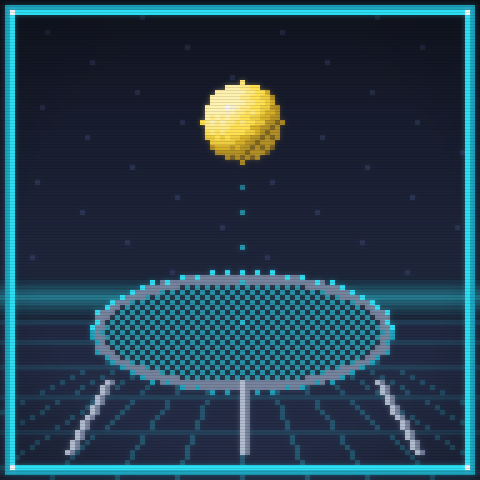
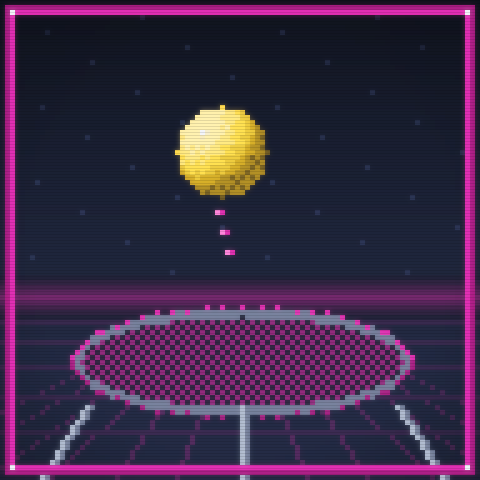
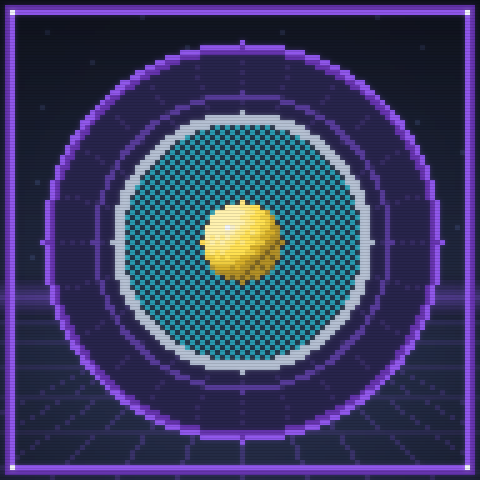
Roundnet is a fast, scrappy team game played around a small circular net that sits on the ground like a tiny trampoline. Two teams of two stand around it. You serve by spiking the ball down onto the net so it rockets up at the other team, and from there it is a wild scramble. Each team gets up to three touches to bounce the ball back onto the net, and there are no sides and no boundaries, so the rally spins 360 degrees around the net and the players move with it. It is volleyball energy crammed into a circle a yard wide.
The joy is how quickly it goes from zero to flying. You can learn it in two minutes on a beach or a backyard, and within a few rallies you are diving, calling shots, and laughing at how a tiny net just made you sprint sideways. It packs down into a bag, sets up in seconds, and works on grass, sand, or gym floors. Few games this portable give you this much heart-pounding, full-body fun.
Roundnet was invented in 1989 by Jeff Knurek, a toy maker who borrowed the basic idea from volleyball and built it around a small bouncy net. The Japanese toy company Tomy picked up the rights in the early 1990s and sold it in US toy stores under the name Spikeball. It had a short burst of popularity from roughly 1989 to 1995, then faded as the early equipment felt dated and the fad cooled off. For more than a decade the game mostly disappeared.
The revival came in 2008, when Chris Ruder and a group of friends rediscovered the game on a Hawaii beach trip and launched Spikeball Inc. in the Chicago area. Ruder bought the old trademark for about $800, made a sturdier set, and pushed it hard online, including a YouTube demo that pulled in over a million views. The company appeared on Shark Tank in 2015, and although it did not land an investment, the exposure sent sales soaring. To protect their brand, the company pushed the generic name roundnet for the sport itself, keeping Spikeball as the brand name. The game exploded across college campuses, beaches, and parks, governing bodies and tournaments formed, and today it counts millions of players worldwide.
Here is the honest truth: roundnet is one of the few games we will tell you to just buy, and that is because the net is the whole game. A good set lives or dies on its tension. The net needs to spring back consistently and firmly, and that calibrated bounce comes from a manufactured rim, taut net fabric, and clips you cannot really fake with materials from the garage. When you shop, look for a set with a rigid five-leg frame that locks together and does not collapse mid-rally, plus a net you can tighten evenly all the way around. The official tournament size is a 36 inch diameter net standing about 8 inches off the ground, and a quality ball pumps up to a 12 inch circumference. Test the bounce if you can: a ball dropped from about 5 feet should pop back up roughly 20 inches off the net. Spend a little more for a tournament or pro grade set with sturdy legs and a tight net. A flimsy one will sag, wobble, and turn a great game into a frustrating one.
For the love of play: build one yourself with the free plans, or let me make it for you.
Three hand-drawn pixel-art takes on this game. Tell me which number wins and I will make it the cover.
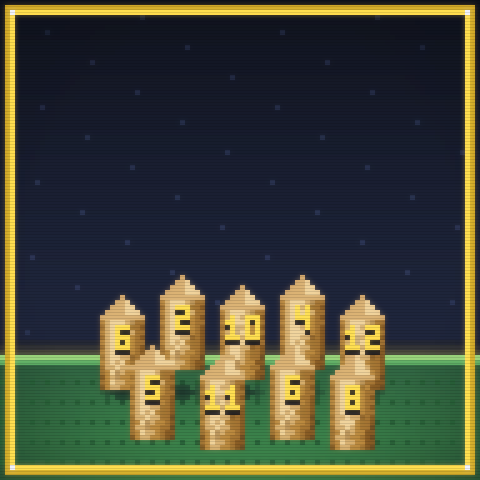
Molkky is a Finnish outdoor tossing game played with a dozen wooden pins numbered 1 through 12 and one fat wooden throwing pin. You set the numbered pins in a tight cluster, step back to the throwing line, and lob the throwing pin underhand to knock pins over. The catch that makes it sing: knock down one pin and you score its number, but knock down several and you only score how many you toppled. So a careful single can be worth more than a messy strike, and you have to think, not just hammer away.
The joy is in the math and the nerves. You are racing to exactly 50 points, and if you blow past it you crash back to 25, so the endgame turns into a delicious game of precision and second-guessing. It is dead simple to learn, it plays great with kids and grandparents and competitive friends all in the same circle, and there is nothing quite like the clack of wood on wood in a backyard on a summer evening. No batteries, no net, no fuss. Just a stick, some pins, and a patch of grass.
Molkky is young as folk games go. The company Lahden Paikka, then known as Tuoterengas, a sheltered work center run by municipalities in the Lahti region of Finland, created and started producing it in the mid 1990s, with the design landing in 1996 and a trademark registered on 30 November 1998. The creators coined the word molkky, which has no real meaning, probably riffing on the Finnish word polkky, which means a block of wood. The game itself draws on a much older Finnish pin-tossing tradition called kyykka, an ancient game that leans on strength and force. Molkky was deliberately built to be gentler and friendlier: more about aim and arithmetic than raw power, so anyone could pick it up and have a good time.
From those Finnish roots it traveled fast. Molkky caught fire in France beginning around 2006, and France grew into the single biggest molkky country in the world, ahead of even Finland, both in sets sold and games played. There is a World Championship held in Finland that has drawn thousands of players. In 2016, Lahden Paikka sold all rights, production, and the trademark to the Finnish company Tactic Games Oy, who carry it today. For a game invented in a small Finnish workshop, it has done remarkably well at putting a simple stick and a circle of numbered pins into backyards all over the planet.
A dozen numbered wooden pins plus one throwing pin, all cut from the same round post. Easy to medium build, one good afternoon with a saw.
⬇ Download the build plansFor the love of play: build one yourself with the free plans, or let me make it for you.
Three hand-drawn pixel-art takes on this game. Tell me which number wins and I will make it the cover.
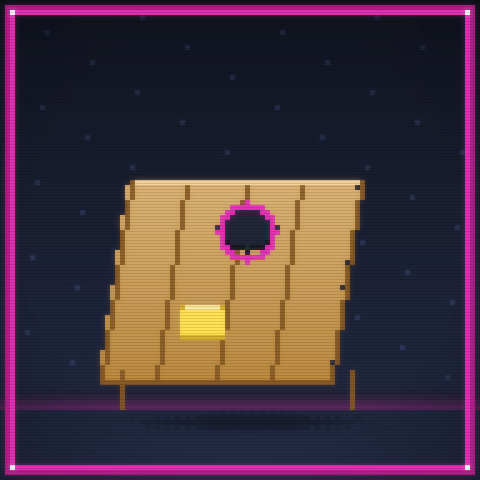
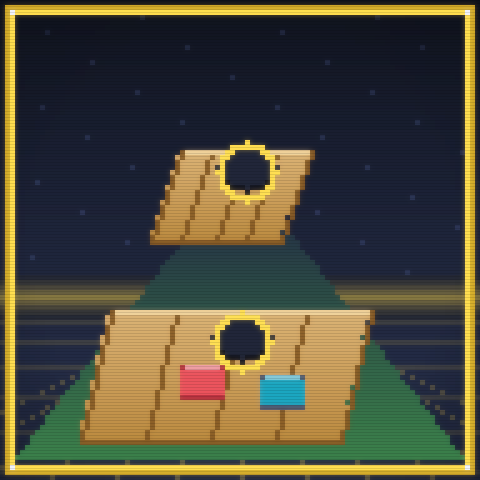
Cornhole is the classic American bag toss: two slanted wooden boards facing each other across the lawn, each with a 6-inch hole near the top, and two teams taking turns pitching bean bags at the far board. Land a bag on the board and you get a point. Sink one through the hole and you get three. It is dead simple to learn, which is the whole magic of it. A six year old gets it in one throw, and so does your uncle holding a burger in his other hand.
The joy is in the rhythm. You throw, they throw, you trash talk a little, you sink a clutch bag, somebody slides a bag into the hole to cancel your whole lead, and the whole backyard groans and cheers. It is the perfect companion to a cookout or a tailgate because you can play with a drink in hand and carry on a full conversation between throws. Easy to start, genuinely satisfying to get good at, and almost impossible not to smile while you play.
Cornhole's deep origins are genuinely murky, and you should be a little suspicious of anyone who tells you they know the whole story. A few origin tales float around: a charming but unverified legend about a 14th century German cabinetmaker, and a theory tying it to a bag-tossing game played by the Blackhawk people of Illinois. What the historical record actually shows is a US patent. In 1883 Heyliger de Windt patented a game he called "Parlor Quoits" that already had the core idea: bean bags pitched at a slanted board with a target hole, though his version used a square hole rather than a round one. So the basic invention is well over a century old.
The modern game, the one you see at tailgates everywhere, took its shape and its name on the west side of Cincinnati in the 1980s, near Ferguson Avenue, and spread out from there into Kentucky and southeast Indiana. For years it was a regional backyard and tailgate tradition before it exploded nationally. Organized play followed: the American Cornhole Association, the American Cornhole Organization, and the American Cornhole League all formed to standardize boards, bags, and rules, and ESPN began televising tournaments, which turned a folksy lawn game into a competitive sport with sponsored players. That is a wonderful arc for a game you can build in your garage.
A pair of 2x4-foot sloped plywood boards with a 6-inch hole, plus eight corn or pellet filled bags. Beginner to intermediate woodworking, one solid weekend.
⬇ Download the build plansFor the love of play: build one yourself with the free plans, or let me make it for you.
Three hand-drawn pixel-art takes on this game. Tell me which number wins and I will make it the cover.
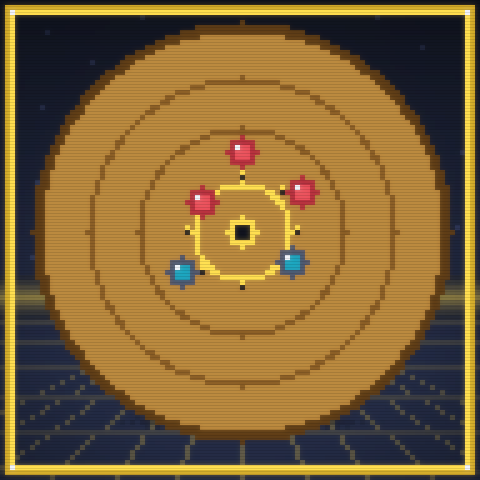
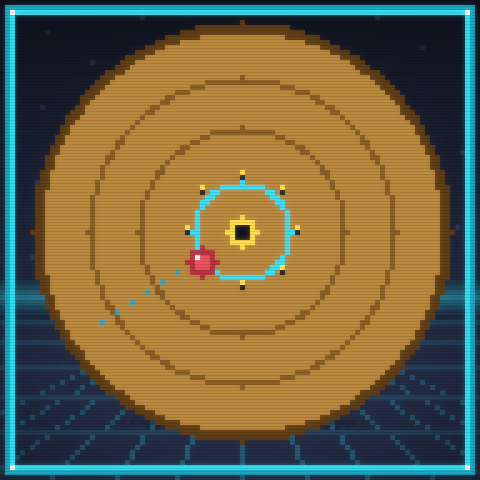
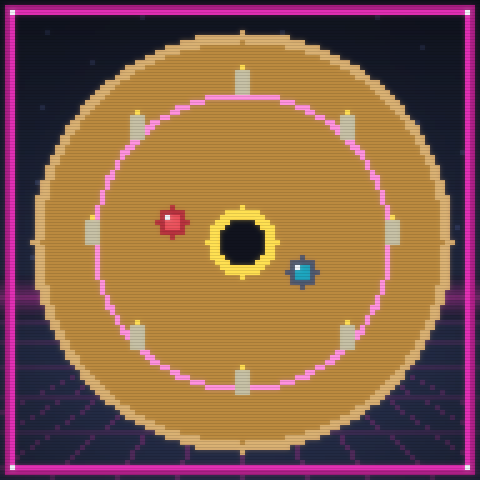
Crokinole is a wooden flicking game where you snap small discs across a round, polished board, trying to land them in or near the center while knocking your opponent's discs away. Think of it as a mix of shuffleboard, carrom, and curling shrunk down to tabletop size. The board has a recessed 20 point hole right in the middle, a ring of eight little pegs guarding it, and scoring rings spreading out from there. The whole thing rewards a soft, accurate touch one moment and a satisfying full-power smash the next.
The joy is in how simple it is to start and how deep it goes. Anyone can flick a disc in thirty seconds, and a five year old can have a blast, but landing a disc cleanly through the pegs into the 20 hole feels incredible every single time. It is quiet, social, and endlessly replayable. You can play a casual round with a kid or get fiercely competitive with a friend over a beverage, and it works just as well either way.
Crokinole comes from rural Ontario, Canada. The earliest known board was made in 1876 by Eckhardt Wettlaufer of Sebastopol, near Tavistock, Ontario, as a fifth birthday gift for his son Adam, who was born on December 31, 1871. That original board now lives in the Joseph Schneider Haus Museum in Kitchener, Ontario. Wettlaufer did not invent the game, he clearly already knew it, which tells us crokinole was floating around before that board ever existed. Most historians trace its roots to a mix of older flicking and sliding games: the 16th century British games of squails and shovelboard (an early shuffleboard), and the carrom games of India and Burma.
The game spread fast across Canada and into the northern United States through the late 1800s and into the 1900s, helped along by Mennonite and other rural communities where it became a family and church-hall staple. It is sometimes called Pichenotte in French-speaking areas. It saw a big revival starting in 1999, when the town of Tavistock launched the World Crokinole Championship, held there every year on the first Saturday of June. Today there is a global competitive scene, but at heart it is still the same friendly kitchen-table game it always was.
A round wooden flicking board with a recessed center hole, eight pegs, and painted scoring rings. Doable for a confident woodworker with a router and patience over a weekend or two: medium difficulty.
⬇ Download the build plansFor the love of play: build one yourself with the free plans, or let me make it for you.
Three hand-drawn pixel-art takes on this game. Tell me which number wins and I will make it the cover.
Bunnock is a backyard throwing game where two teams line up little blocks (originally horse ankle bones, which is why it is called the Game of Bones) and take turns tossing throwers underhand to knock the other team's row down. Think horseshoes meets bowling meets a friendly arms race across the lawn. The catch that makes it sing: you have to topple the opponent's two guards first, then their twenty soldiers, all in as few throws as you can manage.
It is a joy because it scales from goofy to genuinely tactical. Little kids can knock bones over and cheer, while serious players obsess over angles, throw counts, and the perfect underhand glide. It plays slow and social, with plenty of chatter between throws, and it rewards a steady hand over raw strength. A whole afternoon disappears into it, which is exactly the point.
Bunnock almost certainly began in Northern Siberia in the early 1800s, where Russian soldiers stationed in remote, frozen postings needed something to pass the time. The ground was too hard to drive pegs for horseshoes, so the story goes that they set horse ankle bones up on the frozen earth and threw other bones to knock them down. It is widely seen as a cousin of the older Mongolian bone game shagai. The name itself comes from the German word for a horse ankle bone, which is bunnock.
Russian and German immigrants carried the game to Canada in the early 1900s, and most of them settled in Saskatchewan, where it became a beloved farmyard pastime played with real horse anklebones from the farm. The big modern turning point came in the 1960s in the town of Macklin, Saskatchewan. Joseph H. Gartner, who worked at a horse meat processing plant, was allowed to salvage anklebones to make sets, and as demand grew he wrote a rulebook that standardized the setup and play. Macklin embraced the game completely. It hosts the World Bunnock Championships every August, the town nearly doubles in size for the event, and it even built the World's Largest Bunnock, a 9.75 m statue of a horse ankle bone scaled up 98 times, which now serves as the town tourist centre.
An afternoon of cutting and sanding 4x4 lumber into 52 little blocks, then painting four colors. Easy difficulty, about 3 to 4 hours plus drying time.
⬇ Download the build plansFor the love of play: build one yourself with the free plans, or let me make it for you.
Three hand-drawn pixel-art takes on this game. Tell me which number wins and I will make it the cover.
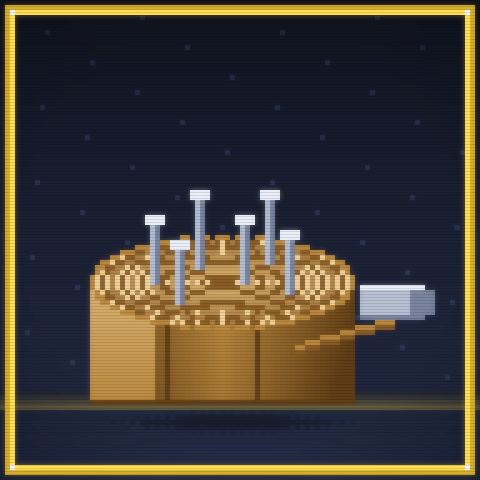
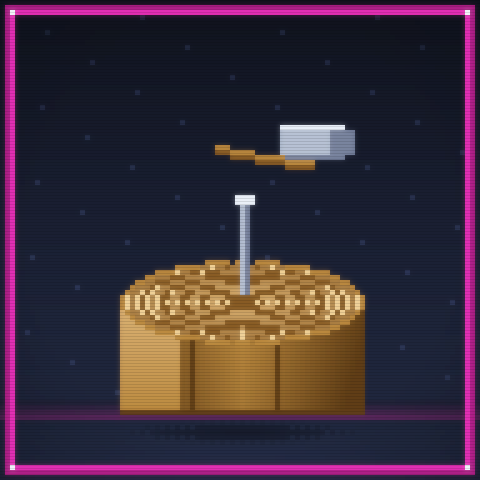
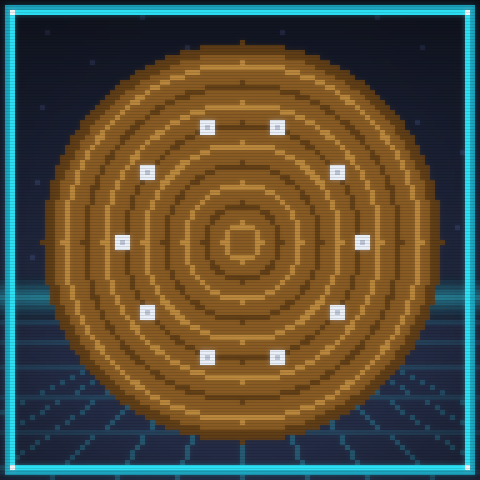
Stump, also called Hammerschlagen, is the gloriously simple game where everybody stands around a log, each person claims a long nail tapped into the top, and you take turns swinging a hammer to drive your opponents' nails flush while keeping your own standing. Last nail standing wins. That is the whole thing, and that is exactly why it is so good.
It is a joy because it rewards a steady eye and a confident swing while staying friendly enough for total beginners. There is real skill to landing a clean strike, a little showmanship in the hammer-flip variations, and a lot of laughing when someone bends a nail sideways or whiffs entirely. It needs almost nothing to play, it works in a backyard or at a party, and a cold drink in your free hand is practically part of the rules. Pure, loud, hammer-swinging fun.
Despite the German name and the Oktoberfest aura, the game most Americans call Hammerschlagen or Stump was popularized in Minnesota, not Munich. Carl Schoene, a German immigrant who came to the United States in 1957, set it up at his family's restaurant, the Gasthaus Bavarian Hunter near Stillwater, in the late 1960s to get people lingering and buying more beer. Schoene's father-in-law, Mike Wlaschin, is credited with coining the Hammer-Schlagen name. The roots do reach back to Germany, though. According to Florian Dering, a museologist at the Munich Stadtmuseum, the nail-beam game existed as folk amusement by the 1920s, where showmen and charities used nail-driving contests to raise money and newlyweds sometimes hammered nails to show off their skill to wedding guests.
From that Minnesota beer hall the game spread across the American Midwest and beyond, turning up at Oktoberfest tents, county fairs, breweries, and backyards. Two parallel traditions grew up: the trademarked, refereed Hammer-Schlagen version with its one-swing, flush-nail format played on a horizontal beam, and the rowdier circle-of-friends game known simply as Stump, with hammer flips and the last nail standing taking the win. The Hammer-Schlagen name became a registered trademark, and a Stillwater company even won a trademark battle over it, which is why you will see the unbranded name Stump used for the casual backyard version.
A round log stump plus a handful of long nails and one hammer. Genuinely easy: a couple of hours if you have a log, mostly drying time and a little sanding.
⬇ Download the build plansFor the love of play: build one yourself with the free plans, or let me make it for you.
Three hand-drawn pixel-art takes on this game. Tell me which number wins and I will make it the cover.
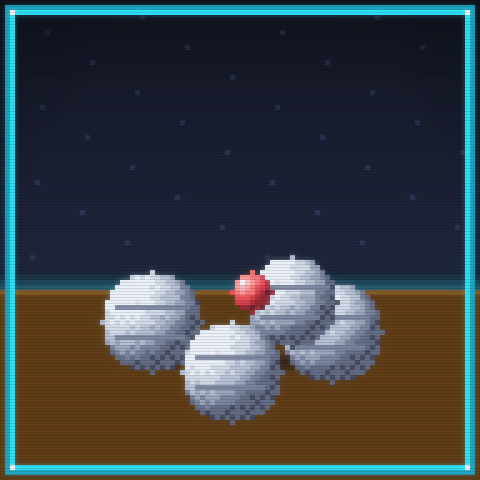
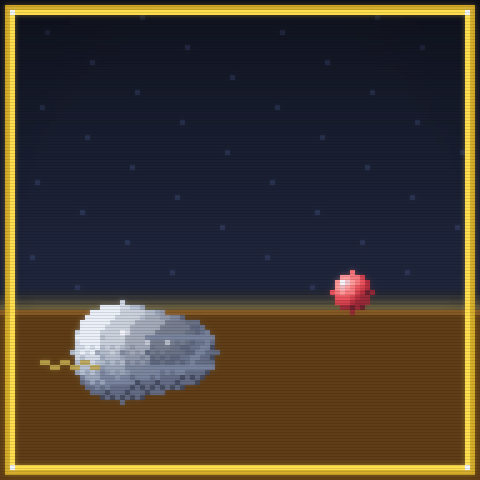
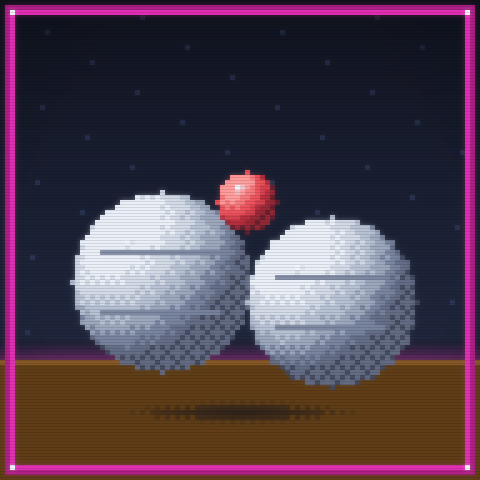
Petanque is the classic French game of boules: you toss a little wooden target ball out onto the dirt, then take turns lobbing heavy steel balls at it, trying to land yours closest. That is the whole heart of it. You stand still with both feet planted in a small circle and you throw. No running, no swinging, no special court. Just a patch of gravel, a sunny afternoon, and the satisfying clack of steel on steel.
What makes it a joy is how it rewards everybody. A six year old can lob a lucky ball right onto the jack and beat a grown adult, and a wily old player can knock your perfect shot clean out of the way with one well aimed strike. It is slow and social by design. You walk down, measure who is winning, argue a little, walk back, and throw again. It is the kind of game where the scoreboard matters less than the company, and that is exactly why people in Provence have been playing it under the plane trees for over a hundred years.
Petanque was born in 1907 in the town of La Ciotat, near Marseille in Provence, France. It grew out of an older, more athletic game called jeu provencal, where players took a running start before throwing. The story goes that a local cafe owner named Ernest Pitiot invented the gentler version for his friend Jules Lenoir, a former player whose severe rheumatism meant he could no longer run or even stand comfortably to throw. Pitiot shrank the pitch by about half and had players throw from a stationary circle with both feet on the ground. They called it pieds tanques, meaning feet planted, in the Provencal dialect of Occitan. That phrase, pe tancat, eventually softened into the name we use today: petanque.
The Pitiot brothers organized the first tournament in La Ciotat in 1910, and the game spread fast. Because anyone could play it on any flat patch of ground, it quickly overtook the older running game and became the most popular form of boules in France. Today it is governed internationally by the Federation Internationale de Petanque et Jeu Provencal, played by millions worldwide, and still treated as a national pastime across France, where a set of boules in the car boot is practically standard equipment for a summer outing.
Petanque is one to buy rather than build, because the whole game lives in the boules and you genuinely cannot fake them at home. A real boule is a hollow steel sphere machined to tight tolerances, between 70.5 and 80 mm across and weighing 650 to 800 g, with the heft and balance to fly true and strike clean. Here is what to look for. For casual family play, a leisure set is perfect: these are usually one piece, often sand filled for weight, sold in a tidy carry case with a small wooden jack, and they will last for years of picnics. If you catch the bug and want to play in a club, step up to competition boules, which are stamped with their exact size and weight and come in carbon steel or stainless. Carbon steel grips the ground beautifully but can rust, so you wipe it down and store it with a little oil or some dry rice. Stainless steel (often labelled inox) never rusts and needs almost no care, which makes it a great choice if you live somewhere damp or near the sea. Match the boule size to your hand and the weight to your strength, pick a slightly smaller, heavier boule if you like to shoot and knock opponents away, and do not forget you need just one little wooden cochonnet for the whole set. A good handmade or club grade set will outlive you, so it is worth buying once and buying well.
For the love of play: build one yourself with the free plans, or let me make it for you.
Three hand-drawn pixel-art takes on this game. Tell me which number wins and I will make it the cover.
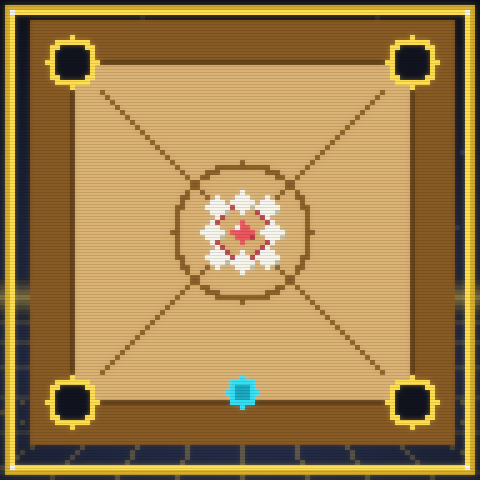
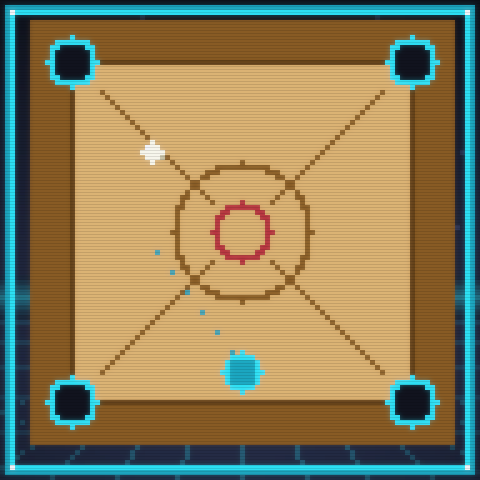
Carrom is a flick-and-strike board game where you snap a heavy disc called the striker across a slick wooden board to knock smaller wooden coins into the four corner pockets. Think of it as a tabletop blend of pool, shuffleboard, and air hockey, all powered by nothing but a flick of your finger. You and your opponent each go for your own color, the prize is the red queen in the middle, and the first to clear their coins wins the board.
The joy of carrom is how fast it pulls you in. The rules are simple enough to learn in two minutes, but the angles, the rebounds, and that satisfying click of a coin dropping into a pocket keep you hooked for hours. It is a game for the whole family on a rainy afternoon, and it is genuinely beautiful to watch a good player run the board on a single turn. Dust the surface with a little powder so the coins glide, and you are off.
Carrom comes from the Indian subcontinent, where it grew up as an indoor game across South Asia. The exact origin is fuzzy, but the game is generally traced to India around the 18th century, and one old story has a glass-surfaced carrom board still sitting in a palace in Patiala, hinting that royalty played a version of it before it spread to everyone else. The name most likely comes from the word carom, which means to strike and rebound, which is exactly what the coins and striker do all game long.
By the early 20th century, state-level competitions were running across India, and serious tournament play is said to have taken off in Sri Lanka around 1935. By 1958 both India and Sri Lanka had formal federations of carrom clubs running tournaments and handing out prizes. The game traveled too: Christian missionaries brought a North American version home around 1890, and it reached Japan in the early 20th century as tokyuban. Today carrom is a beloved fixture in homes across India, Pakistan, Bangladesh, and Sri Lanka, and it is played in dozens of countries around the world under the International Carrom Federation.
A flat plywood board with rounded corner pockets and a tall rebound frame: a satisfying weekend woodworking build, moderate difficulty, roughly one to two days plus finishing time.
⬇ Download the build plansFor the love of play: build one yourself with the free plans, or let me make it for you.